
How Pigment Particle Size Affects Coverage and Reflectivity
November 2, 2026 | by Himanshi Sagar
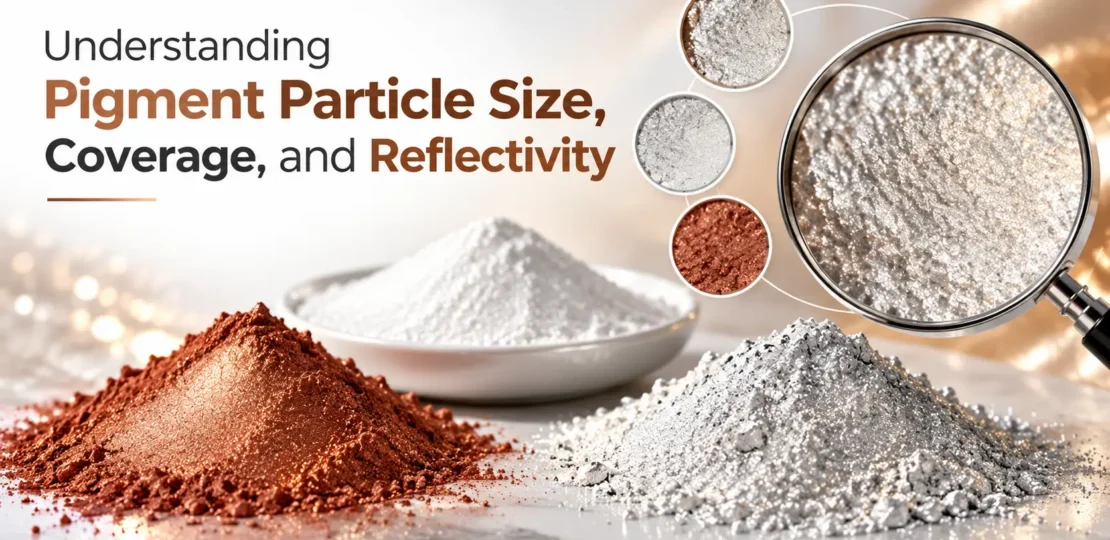
Understanding Pigment Particle Size, Coverage, and Reflectivity
Pigment performance is not determined by colour alone. Factors such as particle size, particle distribution, surface properties, and light interaction play an important role in determining how a pigment looks and performs in its final application.
Whether used in paints, coatings, plastics, cosmetics, printing inks, or automotive finishes, choosing the right pigment particle size can make a noticeable difference in the final result. It influences colour strength, hiding power, surface appearance, brightness, and reflective effects.
For manufacturers, understanding how pigment particle size affects reflectivity is essential when selecting pigments for specific industrial and decorative requirements.
In this guide, we will explore how pigment particle size affects coverage and reflectivity, the differences between fine and coarse pearl pigments, and how to choose the right particle size for different applications.
What Is Pigment Particle Size?
Pigment particle size refers to the physical dimensions of individual pigment particles. It is commonly measured in micrometres, where one micrometre equals one-millionth of a metre.
Manufacturers produce different pigments with different particle sizes, depending on their composition, intended application, and desired visual effect.
For example, a fine pigment may produce a smooth, uniform colour, while a larger effect pigment can create visible shimmer, sparkle, or metallic-like finishes.
Particle size is particularly important in pearl and effect pigments because these materials interact with light differently depending on their size, shape, and surface structure.
Understanding Particle Size Distribution
Particle size distribution describes the range of particle sizes present in a pigment sample.
Two pigments may have the same average particle size but different distributions. One may contain particles of relatively uniform size, while another may contain a wider mixture of fine and coarse particles.
A controlled distribution helps manufacturers achieve consistent colour appearance, dispersion, and application performance.
Why Does Pigment Particle Size Matter?
Pigment particle size directly influences several properties that determine the quality of a finished product.
The most important factors include:
Colour strength: Particle size and dispersion can influence how effectively a pigment develops its intended colour.
Coverage: Particle size affects how light is scattered or transmitted through a coating.
Reflectivity: The dimensions and surface characteristics of effect pigments influence their reflective appearance.
Gloss: Particle size and particle orientation can change the smoothness and brilliance of a finished surface.
Visual effects: Fine particles generally create softer finishes, while larger effect particles can produce more visible sparkle.
For pigment manufacturers and industrial buyers, selecting the correct particle size helps achieve the desired balance between appearance and performance.
Understanding Pigment Coverage and Reflectivity
What Is Pigment Coverage?
Pigment coverage refers to the ability of a pigment-containing formulation to hide the underlying surface or base colour.
It is closely related to hiding power and opacity.
A pigment with good coverage can create a more uniform appearance with less visibility of the substrate underneath.
Coverage depends on several factors:
Pigment particle size and distribution
Refractive index of the pigment
Difference between the refractive indices of pigment and binder
Pigment concentration
Dispersion quality
Coating thickness
Surface characteristics of the substrate
For example, an opaque white pigment used in paint must provide sufficient hiding power to cover the original wall colour.
However, a transparent pearl pigment is usually selected for its decorative appearance rather than complete hiding.
What Is Pigment Reflectivity?
Pigment reflectivity refers to how pigment particles interact with and reflect incident light.
It is especially important in metallic, pearlescent, and interference pigments.
Reflective behaviour depends on:
Particle size
Particle shape and surface structure
Particle orientation
Refractive index
Coating or oxide layer thickness
Formulation transparency
A well-oriented pearlescent pigment can produce a smooth, bright, pearl-like appearance by reflecting light from its layered surfaces.
This is why pigment reflectivity plays an important role in automotive coatings, decorative plastics, cosmetics, and premium surface finishes.
How Does Pigment Particle Size Affect Coverage?
The relationship between particle size and coverage depends on the type of pigment.
For conventional opaque pigments, the optimum particle size is influenced by light scattering, refractive index, and the wavelength of visible light. Simply reducing particle size does not always improve hiding power.
However, in many mica-based pearlescent pigments, smaller particle sizes generally provide better hiding and a softer appearance.
Larger particles usually create more noticeable sparkle but allow more light to pass through the coating.
Understanding the Relationship Between Particle Size and Reflectivity
The relationship between particle size and reflectivity becomes particularly interesting in pearlescent and effect pigments.
Many pearlescent pigments consist of thin plate-like particles, such as mica or synthetic substrates, coated with metal oxides.
When light reaches these particles, some light is reflected from the coating layers while other light travels through or interacts with the layers. This creates the characteristic pearl lustre and, in suitable pigments, interference colours.
Conclusion
Understanding the relationship between pigment particle size, coverage, and reflectivity helps manufacturers select suitable pigments for their specific applications.
Fine particles are generally preferred for softer finishes and better hiding potential in pearlescent systems, while larger particles are useful for creating visible sparkle and decorative effects. However, the final performance also depends on particle distribution, formulation, dispersion, orientation, and application conditions.
At AMP Pearl Pigment Ltd., we understand the importance of selecting suitable pigments for different industrial and decorative requirements.
FAQ
Pearl Pigment Powder is a mica-based pigment with a shimmering, pearlescent effect. It is widely used in industries like plastics, coatings, cosmetics, printing inks, and more to enhance visual appeal and create a metallic or iridescent finish.
Pearl Pigments are versatile and used in:
- Plastics: For decorative plastic products.
- Coatings: Automotive, industrial, and decorative coatings.
- Cosmetics: Nail polish, eyeshadows, and lip products.
- Printing Inks: For screen printing, gravure, and flexographic printing.
- Textiles: For fabric printing and dyeing.
Yes, Amp Pearl Pigment Ltd offers customizable shades and particle sizes of Pearl Pigments to meet specific industry needs.
Yes, our cosmetic-grade Pearl Pigments are non-toxic and safe for use in beauty products. They comply with relevant industry safety standards.
We provide packaging options ranging from small sample packs to bulk packaging based on your requirements.
RELATED POSTS
View all

How Metal Pigment Creates Brilliant Metallic Effects
August 24, 2026 | by Himanshi Sagar
Why Choose a Seeds Polymer Colour Manufacturer? 7 Tips
August 21, 2026 | by Himanshi Sagar

Aluminium Metal Pigments: 5 Industry Uses & Pearl Pigment Effects
November 22, 2024 | by Amp Pearl pigment