
Fluorescent Pigments: 6 Uses, Applications & Benefits
August 19, 2026 | by Himanshi Sagar
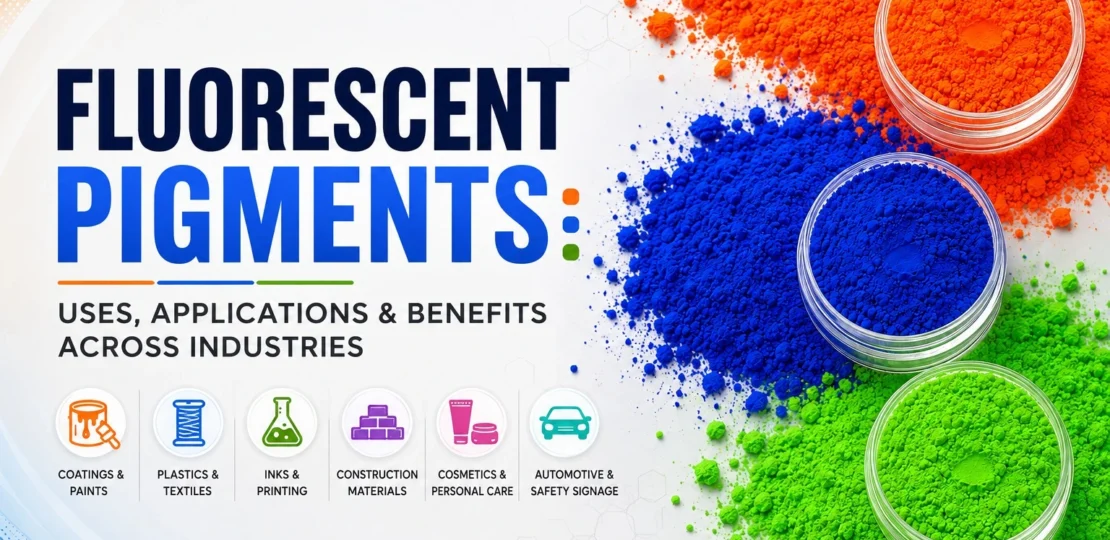
Fluorescent Pigments for Paints, Plastics, Inks & More
Colour with an element of visual appeal can help make a product stand out from the crowd. Here is where the concept of fluorescent pigments comes into play. Fluorescent Pigment designed to provide intense brightness and rich colour performance. The pigments are formulated to absorb ultraviolet light and re-emit it as visible light, providing a glow effect that maximises daylight and UV-light visibility. Where conventional pigments simply reflect specific wavelengths of light that are visible to the naked eye, fluorescent pigments are capable of absorbing shorter-wavelength light and converting part of the energy as visible light. This helps achieve the bright colour effect which is so unique and effective in enhancing colours in appropriate lighting conditions.
In today’s market, fluorescent pigments find use in applications such as paints and coatings, printing inks, plastics, masterbatch, textiles, packaging, rubber goods, decorative products, and certain cosmetic products.
But for manufacturers, brightness is only a part of the issue. Other issues that affect the success of fluorescent pigments include heat stability, light stability, resistance to migration, chemical resistance, dispersibility, and application environment. This guide provides the necessary details on fluorescent pigments, including their definitions, applications, benefits, and selection criteria.
What Are Fluorescent Pigments?
Fluorescent pigments are special colour pigments that yield highly bright and vivid colours through the phenomenon of fluorescence under exposure to proper light conditions.
The phenomenon of fluorescence takes place due to the absorption of electromagnetic waves at certain wavelengths, followed by emission of some portion of the absorbed wavelength in longer visible wavelengths.
Such an optical phenomenon gives rise to the neon, intense or brightly coloured characteristics of fluorescent colours.
Some typical colour shades include:
- Fluorescent yellow
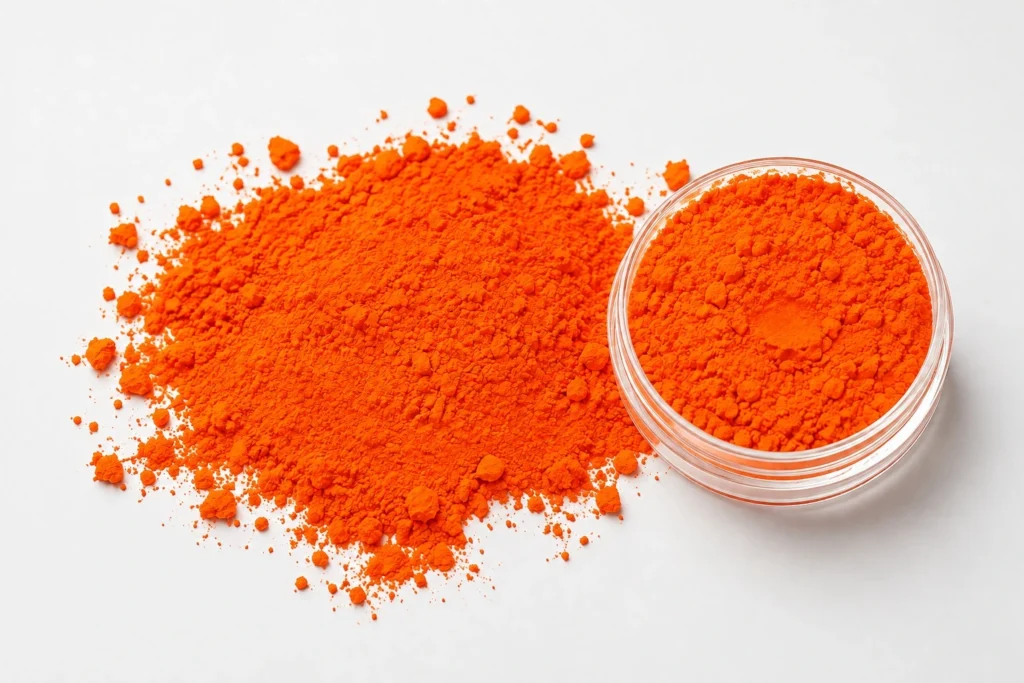
- Fluorescent orange
- Fluorescent red
- Fluorescent pink
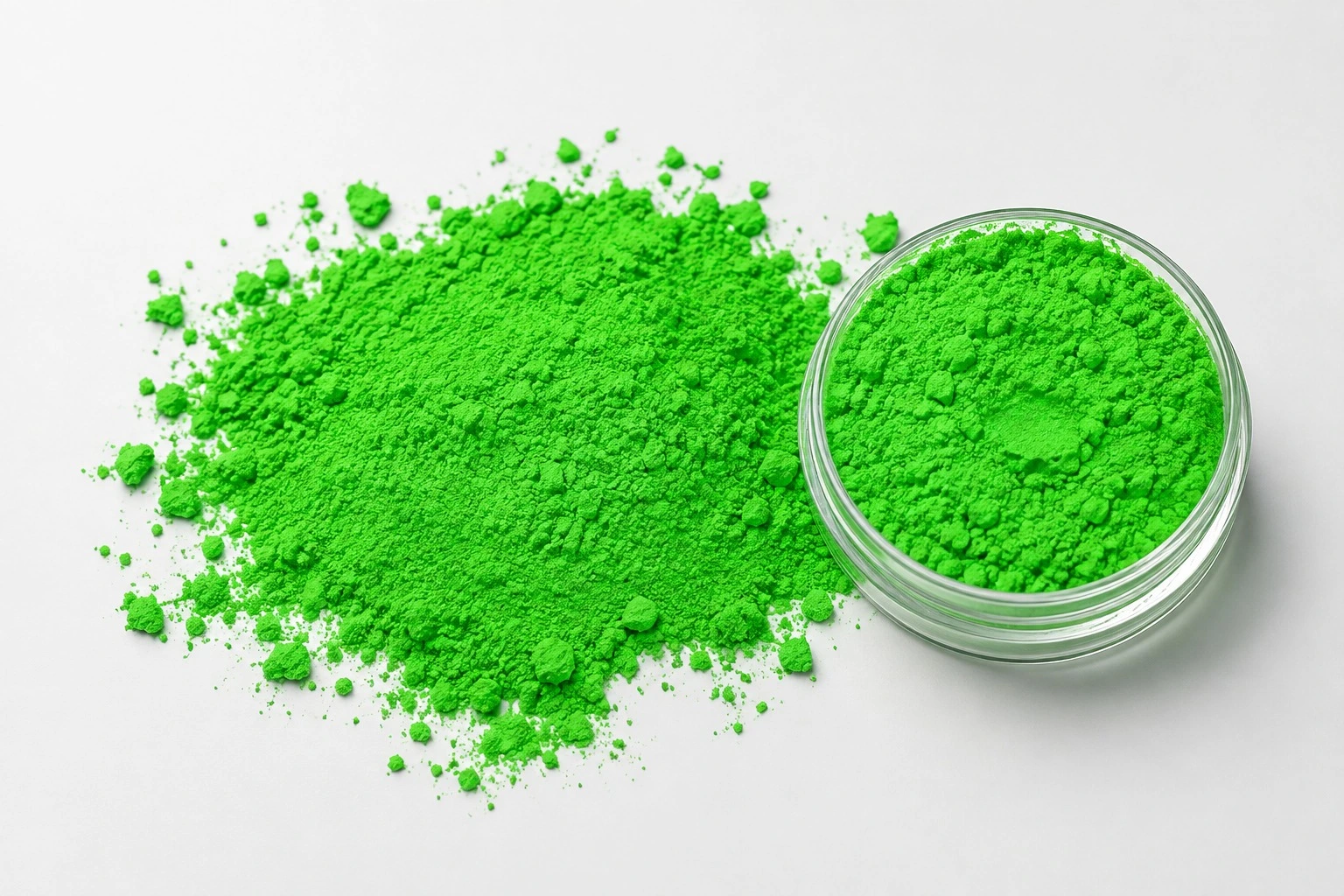
- Fluorescent green
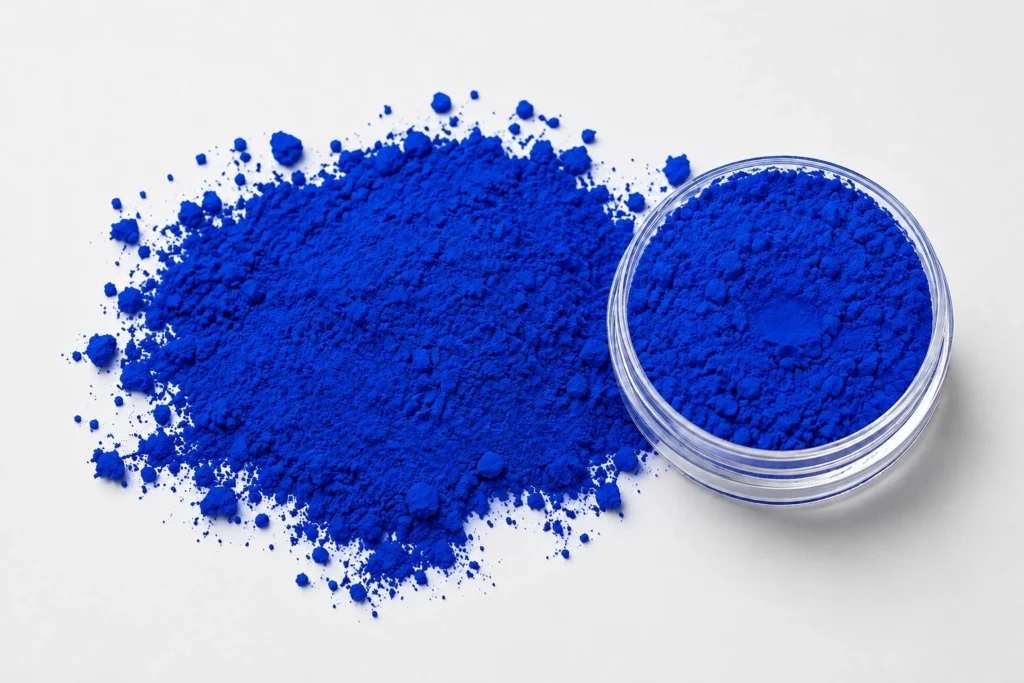
- Fluorescent blue
And other high visibility colours
“Neon” is commonly used as a descriptive marketing term for extremely bright colours, while fluorescence describes a specific optical phenomenon.
Therefore, a product described as a neon colour is not automatically a fluorescent pigment.
How Do Fluorescent Pigments Work?
The most straightforward means of explaining fluorescence involves the discussion of how the color interacts with light.
Fluorescent color is one that:
- Can absorb light energy at specific wavelengths.
- Can temporarily become excited into an energized state.
- Releases some energy in the form of visible light.
- Provides improved visual impact as compared to mere reflection.
This explains the enhanced appearance of fluorescent colors in both natural and specific types of artificial light.
Key Benefits of Fluorescent Pigments
Fluorescent pigments are selected primarily for their visual impact, but they can offer several practical advantages when matched correctly to an application.
1. Exceptional Colour Brightness
The biggest advantage is their intense visual appearance.
Fluorescent colours can help products stand out on:
- Retail shelves
- Printed materials
- Promotional products
- Decorative surfaces
- Textile designs
- Plastic components
- Packaging
This makes them useful when visibility and differentiation are important.
2. High Visual Impact
Bright colours can catch the eye fast.
For instance, a fluorescent orange graphic will contrast more visually with a normal background than a regular orange pigment.
This means that fluorescent pigments can be very appealing for:
- Promotional graphics
- Sports merchandise
- Warning-type graphics
- Event graphics
- Kids merchandise
- Decorative merchandise
Nevertheless, where a product is governed for signaling purposes, one must not assume that it automatically meets the criteria just because it stands out visually.
3. Strong Colour Differentiation
Brands often need a colour that is immediately distinguishable from competitors.
Fluorescent pigments can help create distinctive colour identities for:
- Consumer products
- Packaging
- Fashion products
- Promotional merchandise
- Decorative coatings
- Specialty plastics
4. Versatile Application Potential
Fluorescent pigments may find their applications according to the grade and type of the fluorescent pigment used.
They may be employed in
- Paints
- Coatings
- Ink formulations
- Plastics
- Master batch
- Textile applications
- Rubber applications
- Packaging material
- Decorative industry
- Arts and craft
What is essential to note is that there cannot be a one-to-one correlation between a certain grade of a fluorescent pigment and its applications.
5. Better Product Visibility
In applications where visual recognition is important, fluorescent colours can increase the visual prominence of a product or printed element.
This can be useful in packaging, promotional products and certain high-visibility applications.
Applications of Fluorescent Pigments Across Industries
Fluorescent Pigments for Paints and Coatings
Fluorescent pigments may be employed by paint and coatings companies if there is a need for an attractive coating.
Possible areas of usage are:
- Decorative coatings
- Promotional items
- Event materials
- Signs
- Specialty items
- Decorative finishes inside the house
- Novelty coatings
Factors to take into consideration are:
- Resin/binder type
- Method of application
- Conditions of exposure
If it is to be used outside, light stability and weather resistance gain importance.
BIS mentions that pigments are essential elements of paints, while binders and other components are also contributing factors to the end result.
Fluorescent Pigments for Printing Inks
One of the natural applications of fluorescent colors is printing.
The applications of fluorescent pigments in the area of printing ink are:
- Posters
- Promotions
- Labels
- Decorations/Graphics
- Graphics for packaging
- Point of sale material
- Specialty printing items
- Key considerations are:
- Dispersion
- Viscosity of ink
- Process of printing
- Base or substrate
- Color strength
- Scuff resistance
- Lighting
- Drying conditions
A good-performing pigment in one system of printing may need to have its formulation changed in other printing systems.
Fluorescent Pigments for Plastics
Colourants are used by plastic producers to develop unique plastic products.
Fluorescent colouring for plastics could be used for:
- Consumer goods from plastics
- Toys
- Decorative items
- Promotional items
- Household items
- Plastic parts
- Special plastic mouldings
The most important technical issue is processing temperature.
Some fluorescent colouring is not thermally stable enough as compared with the pigments for hot plastics.
What should plastic manufacturers check?
Before production, check:
- Processing temperature
- Residence time
- Polymer type
- Dispersion behaviour
- Migration resistance
- Colour strength
- Compatibility
- Final-use requirements
A laboratory trial can help identify whether the pigment retains the required colour after processing.
Fluorescent Pigments for Masterbatch
The use of masterbatch offers a useful technique for adding colour to the polymer system.
Fluorescent pigments suitable for the manufacture of masterbatch need to be tested for compatibility with:
- Resin
- Temperature
- Extrusion conditions
- Pigment loading
- Need for dispersion
Dispersion is very important.
Poor dispersion could lead to:
- Colour streaking
- Uneven appearance
- Specks
- Less intense colouring
Manufacturers of masterbatch do not only seek high pigment loading in their products. High pigment loading together with proper dispersion is the goal.
Fluorescent Pigments for Textiles
Fluorescent colors can produce attractive fabric prints.
Fluorescent pigments for textiles can find applications in textile printing processes and decorative purposes.
Textile printing using pigments involves the use of a binder to bind pigment particles to the fiber surface. According to the American Association of Textile Chemists and Colorists, pigments are commonly used in textile printing, and fluorescent pigments have the same optical properties as fluorescent dyes.
The applications could be:
- Fashion prints
- Sportswear prints
- Decorative textiles
- Promotional textiles
- Children’s prints
- Performance factors could include:
- Resistance to washing
- Rub resistance
- Binder compatibility
- Brightness of color
- Feel of print
- Exposure to light
Fluorescent Pigments for Automotive Coatings
Appearance and durability may have to co-exist in applications involving the automotive sector.
In the case of fluorescent pigments for automotive coatings, it may be useful to consider their application in specialized automotive coatings.
But automotive coatings may be subject to:
- Ultraviolet light
- Temperatures
- Water
- Chemicals from roads
- Cleaning
- Scratching
- Weathering
Hence, manufacturers need to focus on weatherability.
The fluorescent pigment selected for maximum brightness alone may not be the best choice for exterior automotive coating.
Fluorescent Pigments for Cosmetic Applications
Special precautions have to be taken with cosmetic applications.
Just because a fluorescent pigment is acceptable for industrial use does not mean it is acceptable for cosmetic use.
The regulatory acceptance varies according to the particular color additive, the jurisdiction, product, and use intended.
For example, the United States Food and Drug Administration says that color additives used in cosmetics shall meet the approval, identification, specification, and restrictions for use. Only some fluorescent colors, according to the FDA, can be used in cosmetics.
Consequently, cosmetic manufacturers need to establish:
- Regulatory status
- Cosmetic use intended
- Purity specification
- Limits for heavy metals if any
- Documentation by supplier
- Documentation by batch
- Jurisdictional requirements
Fluorescent Pigments for Arts and Crafts
Arts and crafts are among the more accessible applications for bright fluorescent colours.
They can be used in:
- Craft paints
- Decorative projects
- Posters
- Artwork
- DIY products
- School projects
- Event decorations
Their high visual impact makes them useful when the goal is to create bold and expressive designs.
For consumer products, however, manufacturers should still consider product safety, labelling and applicable regulations.
Conclusion
Fluorescent pigments provide manufacturers with a convenient way of producing very bright and eye-catching colours.
In paints and coatings, printing inks, plastics, masterbatch, textiles, packaging and decoration materials, unique optical properties of these materials may contribute to improved visual appearance of a product.
Nevertheless, the brightest pigment is not necessarily the best one.
Good pigment choice depends on many factors including:
- Colour strength
- Dispersion
- Thermal stability
- Light stability
- Chemical stability
- Compatibility with an application
- Processing conditions
- Regulatory issues
For special applications like cosmetics, packaging and automotive coating, it is especially important to pay attention to technological and regulatory requirements.
If you are interested in purchasing fluorescent pigments in bulk, consult an experienced pigment manufacturer regarding your application, desired shade, processing conditions, performance expectations, and end uses before selecting a particular grade.
Are you looking for a solution for your industrial application like plastics, coatings, printing ink, textiles, etc.? Please contact us to get more information about your pigment needs.
FAQ
Pearl Pigment Powder is a mica-based pigment with a shimmering, pearlescent effect. It is widely used in industries like plastics, coatings, cosmetics, printing inks, and more to enhance visual appeal and create a metallic or iridescent finish.
Pearl Pigments are versatile and used in:
- Plastics: For decorative plastic products.
- Coatings: Automotive, industrial, and decorative coatings.
- Cosmetics: Nail polish, eyeshadows, and lip products.
- Printing Inks: For screen printing, gravure, and flexographic printing.
- Textiles: For fabric printing and dyeing.
Yes, Amp Pearl Pigment Ltd offers customizable shades and particle sizes of Pearl Pigments to meet specific industry needs.
Yes, our cosmetic-grade Pearl Pigments are non-toxic and safe for use in beauty products. They comply with relevant industry safety standards.
We provide packaging options ranging from small sample packs to bulk packaging based on your requirements.
RELATED POSTS
View all

Discover 10 Amazing Benefits of Premium Sculpture Pigments
December 11, 2024 | by Amp Pearl pigment

Epoxy Grouts with High-Performance Pigments from Amp Pearl Pigment
May 17, 2025 | by Amp Pearl pigment
Resin Art: The Alluring World of Color and Creativity with Premium Resin Art Pigments
November 27, 2024 | by Amp Pearl pigment